
Refugee Roulette: where Justice depends on...the judge assigned.
By James Larsen, Managing Attorney and advocate for asylum seekers around the country.
Having practiced before the Immigration Courts in Omaha, Minneapolis, and Chicago, and most recently in San Antonio and Miami, where different dynamics persist, I've witnessed firsthand the profound impact judges can have on the futures of asylum seekers. Recent insights from Minnesota and contrasting data from Utah highlight the wide disparities in judicial approaches to asylum and their profound implications for those seeking refuge in America.
Omaha's Unyielding Courtroom: Highest Denial Rates in the Country
In Omaha, Judge Alexandra Larsen (no relation) presides over a courtroom where the majority of asylum seekers face an uphill battle. Larsen, along with her colleagues on the bench in that city, has a track record of denying over 96% of asylum applications, reflecting a stringent interpretation of asylum law that has made Omaha one of the toughest courts in the nation for asylum seekers.
The Omaha Immigration Court presents a formidable challenge for asylum seekers, primarily due to its judges' backgrounds as former prosecutors with Immigration and Customs Enforcement (ICE). Judges like Alexandra Larsen, Abby Meyer, and Matthew Morrissey bring prosecutorial perspectives to their roles, which often result in high denial rates for asylum applications.
I remember when Matthew Morrisey defended clients from removal proceedings in private practice. As members of the Iowa-Nebraska American Immigration Lawyer's chapter, we felt betrayed when he switched sides to join Immigration and Customs Enforcement's Office of Chief Counsel as an immigration prosecutor.
This prosecutorial background likely influences a judge's interpretation of asylum law, possibly making it particularly more difficult for Central American and Mexican applicants, who comprise the majority of cases, to secure protection. Critics argue that these judges' previous roles influence their adjudications, contributing to Omaha's reputation as one of the toughest immigration courts in the country for asylum seekers.
Utah's Remarkable Approval Rates: Contrasting Perspectives
In contrast to Omaha's stringent climate, Utah boasts remarkably high approval rates for asylum cases, with some judges approving up to 67% of applications. This disparity underscores the significant role judicial philosophy and regional variations play in asylum adjudications across the United States. For asylum seekers in Utah, these statistics offer a more promising outlook and a higher probability of finding safety and protection from persecution.
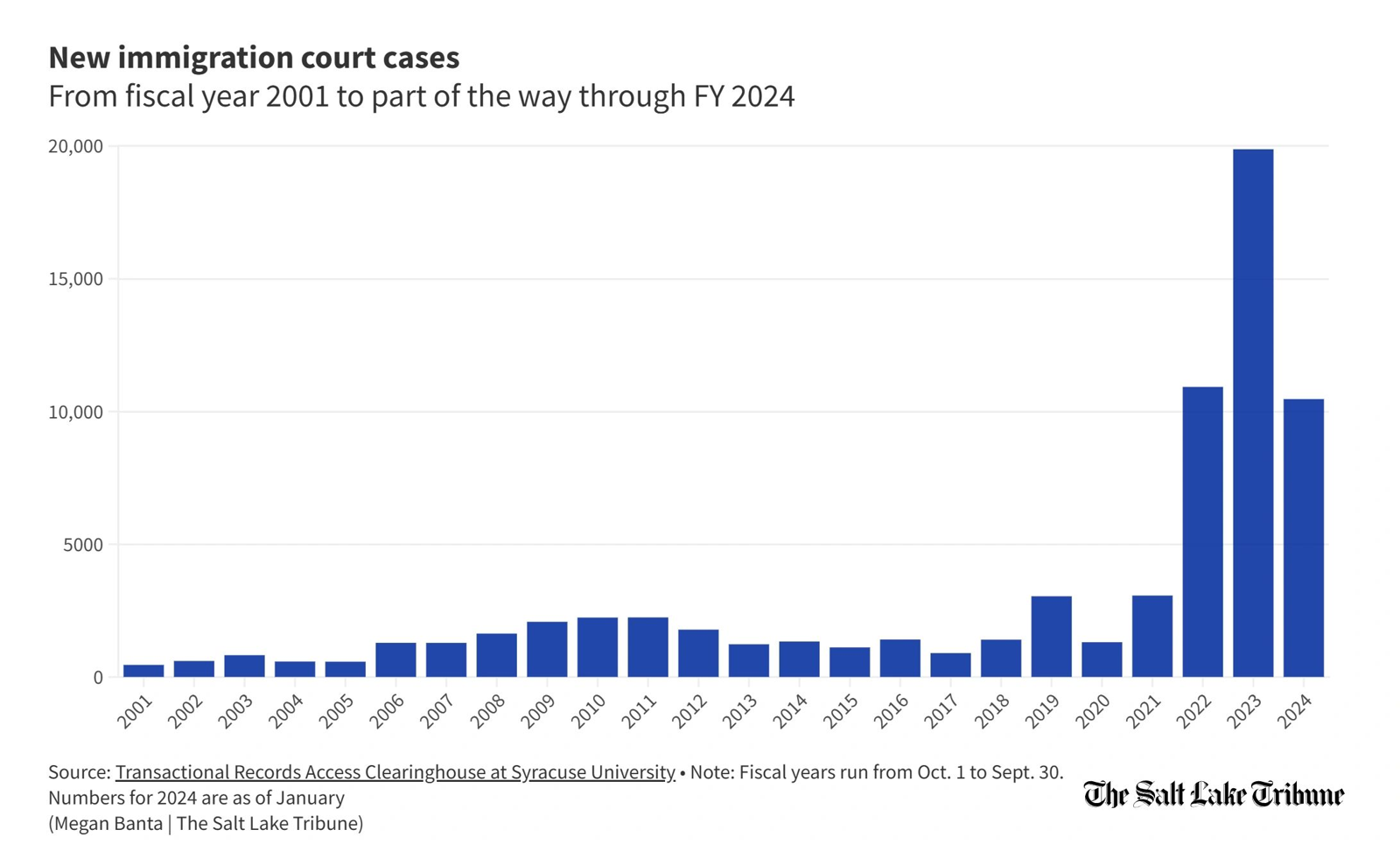
Utah has seen a dramatic increase in immigration court cases, with migrants listing Utah addresses growing more than sixfold from 2021 to 2023, according to data from Syracuse University's Transactional Records Access Clearinghouse. This surge marks a 548% rise over two years, reaching nearly 20,000 cases in 2023 alone. Salt Lake County accounts for the majority of these cases, reflecting about 67% of all immigration filings in the state. The influx, largely from Venezuelan immigrants, has strained local resources, with Catholic Community Services of Utah reporting ongoing demand for services, including legal assistance and refugee support programs. The trend underscores Utah's emerging role as a significant destination for asylum seekers amid broader nationwide shifts in immigration patterns.
Contrasting Approvals: Minnesota's Judge Hansen vs. Judge Miller
The immigration court at the Whipple Federal Building in Fort Snelling, Minnesota, exemplifies the stark disparities asylum seekers face based on judicial assignment, even within the same city. Judges like Katherine L. Hansen, a former district judge with a 60% approval rate, contrast sharply with Monte G. Miller, who approved only 11% of asylum cases as a former prosecutor.

This discrepancy underscores a nationwide phenomenon dubbed "refugee roulette," where the judge assigned can significantly determine an asylum seeker's fate. Across the United States, asylum approval rates vary widely, influenced by judges' backgrounds and interpretations of immigration law. Critics argue that former prosecutors and ICE representatives on the bench at Fort Snelling contribute to the court's reputation as particularly stringent, complicating the prospects for those seeking refuge from persecution. The importance of judicial assignments is evident in outcomes like those faced by asylum seekers in Minnesota, where legal representation and judge selection play pivotal roles in navigating a complex and often unforgiving system.
Judge Hansen, known for her comparatively higher approval rate, adopts a patient and supportive approach, encouraging applicants to pursue the asylum process diligently. Conversely, Judge Miller's starkly lower approval rate reflects a more stringent stance, complicating the prospects of asylum seekers who face a challenging path under Miller's adjudication.
Advocating for Reform: Ensuring Fairness
A 2024 report by the ACLU of Nebraska highlighted significant concerns regarding due process violations in Omaha's Immigration Court. Based on data from over 500 pretrial hearings between April and August 2023, the report reveals widespread deficiencies in procedural rights for immigrants. Key findings include judges failing to inform individuals of their rights in over 80% of cases and interpretation services predominantly offered in Spanish rather than individuals' preferred languages. Dylan Severino, the lead author of the report, emphasized that these errors constitute serious violations of constitutional rights, particularly critical in cases involving asylum seekers facing potential life-threatening situations upon deportation.
Other issues noted were the brevity of hearings—typically less than four minutes—and the fact that nearly 20% of immigrants appeared without legal representation. Severino advocated for "universal representation," proposing publicly-funded legal counsel for all individuals facing detention or deportation who cannot afford an attorney. He underscored the significant impact legal representation can have on immigrants' ability to navigate the legal system and contribute positively to society, stressing that supporting immigrants aligns with both economic and cultural benefits historically celebrated in the United States. The report's findings contribute to ongoing legislative efforts, such as the 2023 Fairness to Freedom Act, aimed at establishing universal representation as a federal standard across the country.
As an advocate and practitioner, my experiences in Omaha, San Antonio, Minnesota, and beyond compel me to push for reforms that uphold due process rights and ensure fairness in asylum proceedings. The disparities in judicial outcomes underscore the urgent need for systemic reforms that prioritize human dignity and uphold the principles of justice and compassion for all asylum seekers.
In conclusion, my journey through these diverse immigration courts has illuminated the stark realities and persistent challenges faced by asylum seekers across America. The statistics on approval rates across different states highlight the need for a more equitable and humane asylum adjudication process that honors the rights and dignity of every individual seeking refuge on our shores.
For a consultation regarding your asylum case, please contact Larsen Immigration Law Group at 512-648-9115 or e-mail info@larsenimmigration.com
Immigration law changes rapidly. This article is for informational purposes only, reflects the law as of its publication date, and may be superseded by later changes in the law, regulations or agency policy. It is not legal advice, and reading it does not create an attorney-client relationship.La ley de inmigración cambia rápidamente. Este artículo es solo para fines informativos, refleja la ley a la fecha de su publicación y puede quedar superado por cambios posteriores en la ley, las regulaciones o las políticas de las agencias. No es asesoría legal, y leerlo no crea una relación abogado-cliente.