
Texas Immigration Law Has Troubling Copycat in Iowa, Other States
By Managing Attorney James Larsen. May 19th, 2024, Des Moines, Iowa
I''ll never forget the electrifying atmosphere at the American Immigration Lawyers Association Conference in June of 2013. Attorneys leaped from their seats, tears of joy streaming down their faces as they hugged and high-fived each other. The U.S. Senate had just passed a comprehensive immigration reform bill with an overwhelming majority vote of 66-32. For a brief moment, there was a sense of optimism that our nation's broken immigration laws would finally be addressed.
As a young attorney at the conference, I soon realized that the euphoria was short-lived. Despite the Senate's approval, the bill ultimately died in the legislative process. Now, ten years later, the situation has only worsened.
We're seeing a troubling trend unfold. Multiple states are pushing ahead with draconian laws that directly challenge federal immigration policies, exacerbating polarization and deepening divisions across the nation. The border standoff between Texas and the federal government, highlighted by the passage of Texas SB4, has captured national attention, thrusting the issue of state-driven immigration enforcement into the forefront of political discourse.
Yet, Texas is just one state among many. From coast to coast, multiple states are engaged in a race to the bottom, each attempting to outdo the other with increasingly stringent legislation. This relentless pursuit is plunging millions of undocumented immigrants into a state of heightened uncertainty and fear, further underscoring the urgent need for comprehensive immigration reform.
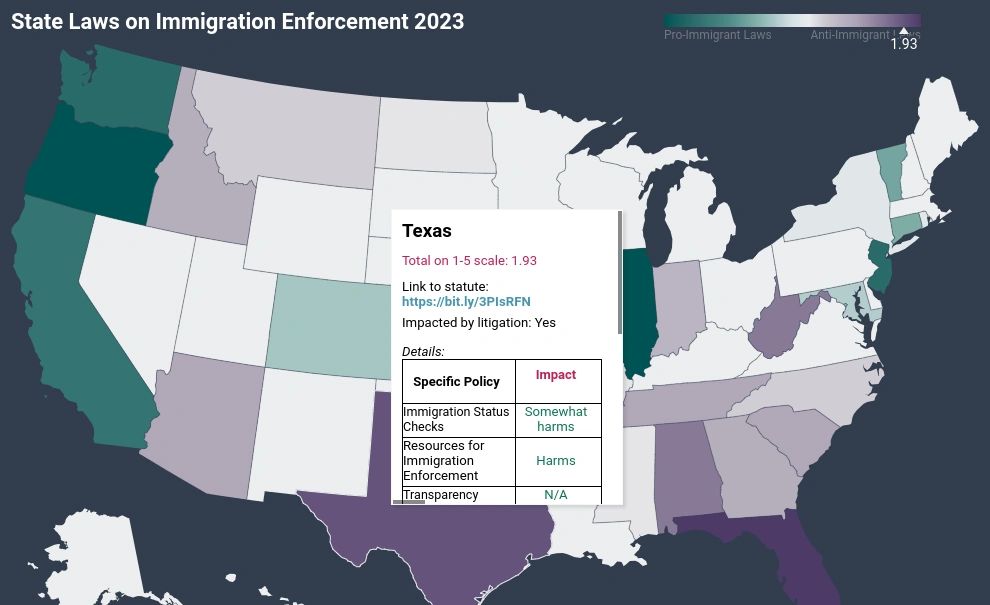
Iowa Raises the Stakes with Immigration Legislation Directly Contravening Federal Law
This spring, the Iowa legislature's consideration of SF 2340, a law mirroring portions of the Texas law, has sent shockwaves through immigrant communities across the Hawkeye State.
“This bill will impact everyone who is an immigrant, legal or not, those who look like they could be an immigrant, and all those who care about those community members,” said Immigrant Allies member Joa LaVille, She claimed the bill gives a permission slip for racial profiling. “So an awful lot of people in Marshalltown will be affected. In addition, this bill would undo years of proactive efforts by our law enforcement community to build trust with the immigrant community, which leads to a safer community for all of us.”
Despite these concerns, Iowa's legislature forged ahead and the law was passed last month. Set to take effect on July 1, 2024, it the new law state officials authority to arrest, detain, and remove non-citizens who have reentered the United States after being deported—even if the person returned with permission from the federal government or later gained lawful immigration status. It essentially creates new crimes for anyone in Iowa, including a child, who has re-entered the country after being deported, even if that person is now authorized to be in the U.S. Like numerous other state laws relating to immigration, the Iowa law has been challenged in court.

This past week, two lawsuits were filed challenging Iowa's SF 2340. The Iowa Migrant Movement for Justice (Iowa MMJ) and two Iowa residents filed their complaint on May 9, while the Department of Justice brought its own lawsuit on the same day.
The legal argument against SF 2340 centers on its clear violation of the Constitution and its disruption of U.S. immigration law and foreign policy. Both lawsuits contend that Iowa lacks the authority to create its own immigration enforcement and removal process, as only the federal government has that jurisdiction. SF 2340 would empower untrained state officials to prosecute and remove noncitizens, potentially causing inconsistencies in immigration law implementation and disrupting U.S. foreign relations.
The harm caused by SF 2340 is already evident in immigrant communities across Iowa, where fear of racial profiling and family separation is widespread. The law risks eroding trust in local law enforcement and hindering crime reporting and victim protection efforts. Immigrants, including green card holders and asylum seekers, face the threat of arrest, prosecution, and deportation if the law is allowed to proceed, underscoring the urgent need for federal court intervention.
Texas Set Troubling Precedent With Passage of Draconian SB4
Senate Bill 4 was the controversial Texas law, not currently in effect as of May 19, 2024, that empowers state and local law enforcement agencies to enforce immigration law.
Specifically, the Texas legislation grants untrained police officers the authority to carry out immigration enforcement activities. It establishes an unprecedented and constitutionally dubious procedure allowing Texas law enforcement to detain individuals suspected of being non-U.S. citizens attempting to enter Texas from Mexico or other countries without proper authorization. Under this law, individuals may be charged with a new state offense termed "illegal entry" to Texas, carrying a maximum penalty of 6 months in jail. Furthermore, individuals previously denied entry to the U.S. or deported, including those unlawfully deported by Texas, may face charges of "illegal re-entry" to Texas, punishable by imprisonment ranging from 10 to 20 years.
Additionally, this legislation empowers—and in certain circumstances mandates—Texas judges, who lack training in immigration law and lack proper jurisdiction to enforce it, to issue deportation orders against individuals. Those who do not comply with these orders may be charged with a newly established crime of refusing to adhere to the state's deportation directive, punishable by imprisonment ranging from 2 to 20 years.
Originally set to take effect in March of 2024, the law was challenged before and after passage. The Biden administration and the American Civil Liberties Union sued to invalidate the law, arguing it was an unconstitutional intrusion on federal enforcement of immigration law, and successfully secured a preliminary injunction. The state of Texas appealed the injunction to the 5th circuit court of appeals, which turned to the U.S. Supreme Court for guidance on the injunction. The U.S. Supreme Court struck down the injunction, only for the appeals court to block the law from going into effect on other grounds.
“No matter how emphatic Texas’s criticism of the federal government’s handling of immigration on the border may be to some,” Judge Ezra wrote in his 114-page decision, “disagreement with the federal government’s immigration policy does not justify a violation of the Supremacy Clause” of the Constitution."
SB4 remains blocked, for now, as it makes its way through the federal court system. This back and forth, ping-pong continues, contributing to confusion, and chaos.
Unfortunately, SB4 served as a model for several other states, including Iowa, who have enacted or attempted to enact copy-cat legislation.
Arizona, Alabama, Florida, and Other States
Despite numerous setbacks from the U.S. Supreme Court, states persist in testing the boundaries of crafting their own immigration laws. This trend is not new. In 2012, the Supreme Court struck down key provisions of Arizona's immigration law, including those requiring legal immigrants to carry registration documents at all times and allowing state police to arrest individuals suspected of being illegal immigrants. The court's ruling reaffirmed that immigration policy is under federal jurisdiction, preventing a patchwork of state laws that interfere with federal enforcement, foreign policy, and the rights of lawfully present aliens. But the damage had already been done.
A 2010 article in the New York Times captured the chilling effect such laws have had from the time they are enacted until the tim they have been struck down by the courts:
Clutching a copy of a Spanish-language article on the tough new law making it a state crime for illegal immigrants to be in Arizona and requiring those suspected of being violators to show proof of legal status, Eric Ramirez, 29, still waited on a corner for work. He nervously kept watch for the police and wondered what his future held.
"
We were already afraid, and I was thinking of leaving for California,” Mr. Ramirez said as he waited on the corner in a heavily Latino enclave already drained of people by the recession and the fear of police harassment. “We shop in their stores, we clean their yards, but they want us out and the police will be on us.”
This pattern continues years, with Florida yet another state to face legal challenges over its attempts at implementing immigration enforcement measures. Portions of a 2021 Florida immigration law were recently struck down by a federal judge, who deemed the law racially motivated.
In her written opinion, U.S. Judge Beth Bloom wrote, "Allowing anti-immigrant hate groups that overtly promote xenophobic, nationalist, racist ideologies to be intimately involved in a bill’s legislative process is a significant departure from procedural norms,” Bloom wrote. “This involvement strongly suggests that the Legislature enacted SB 168 to promote and ratify the racist views of these advocacy groups.”The law banned local government sanctuary policies and mandated local law enforcement's cooperation with federal immigration authorities.
Yet that decision did not seem to deter Florida's Governor from signing three new bills further tightening criminal prosecutions for undocumented immigrants in Florida. These bills, including Senate Bill 1036, House Bill 1451, and House Bill 1589, impose harsher penalties on undocumented immigrants, including enhanced sentences for repeat illegal entry and restrictions on accepting IDs issued to illegal aliens by other jurisdictions.
While states like Florida continue to push aggressive immigration measures, their efforts will continue to face legal and constitutional scrutiny.
Collateral Damage to Human Rights, State and Local Government Budgets, Judicial System
As other states consider enacting similar measures, it's critical to examine the issues of these provisions and the havoc they wreak on the lives of countless individuals and on the limited funds and resources available to state and local governments.
The core issue with these laws lies in their shortsightedness and disregard for basic human rights. By empowering local police to arrest undocumented immigrants and giving state judges the authority to order deportations, these laws set a dangerous precedent, fostering an atmosphere of fear and uncertainty, where even long-standing community members are left feeling powerless and frustrated.
What's particularly troubling is the lack of clarity surrounding enforcement and funding, compounded by the potential for racial profiling. Should states be allocating already scarce resources to pursue millions of immigrants? Who will bear the costs of their detention? What about the expenses of court proceedings, ultimately shouldered by taxpayers? A seldom-discussed aspect of these laws is the obligation to provide legal representation for undocumented immigrants in state criminal proceedings. The Constitution guarantees the right to counsel, with the state responsible for representing indigent defendants.
With millions of undocumented immigrants in the United States, the administrative costs of detention and criminal prosecution would strain the finances of most states, and some states already allocate very little to public defense. An Austin Chronicle investigation in 2023 for example, revealed that the State of Texas has punted 87% of funding responsibilities for public defense to already cash-strapped counties. It's utterly nonsensical to enact and enforce laws that lack clear guidelines for application, especially without a funding mechanism.
When even legal residents feel compelled to flee a state due to a pervasive sense of being undervalued and unsafe, it's glaringly obvious that something is deeply wrong.
Call to Action to Advise the Immigrant Community of Their Rights
Several states have passed laws granting state and local law enforcement the authority to arrest, detain, and deport immigrants. However, these laws do little to address the root causes of immigration; instead, they exacerbate existing tensions. By criminalizing individuals who are simply seeking a better life, these policies perpetuate harmful stereotypes and deepen divisions within society. Furthermore, they can wreak havoc on the economies of agricultural sectors and small towns, which rely heavily on immigrant labor.
Immigration is a multifaceted issue that cannot be resolved through punitive measures alone. As tensions simmer at the U.S.-Mexico border and political rhetoric reaches a boiling point, it's more crucial than ever to pursue humane and equitable solutions. Yet, instead of fostering meaningful dialogue and understanding, these laws only serve to further polarize communities and sow discord. It's time for a more compassionate and pragmatic approach to immigration policy.
History has shown us the folly of such divisive legislation. The echoes of the Arizona's botched immigration law are striking, with the Supreme Court ultimately striking down most of its provisions. While legal challenges may momentarily delay the implementation of these laws, the damage they inflict on immigrant communities is both immediate and enduring.
In the face of this uncertainty, immigrant advocates must mobilize with urgency to safeguard immigrant communities and uphold their rights. By providing crucial legal assistance, hosting community forums, and offering resources for safety planning, we can bolster the resilience and determination of those impacted by these misguided policies.
The ACLU provides some excellent "Know Your Rights" resources. This includes resources specific to SB4 in Texas, from which there are principles of widespread application under federal and U.S. constitutional law.
Community Outreach
The Larsen Immigration Law Group will be providing a series of Know Your Rights educational presentations in the coming months based on the most recent developments in Texas, Iowa, and elsewhere. If your church or organization is interested in hosting a Know Your Rights session, please reach out to Priscila Dominguez at info@larsenimigration.com or call 512-648-9115.
Amidst these turbulent times, it's imperative to recognize that our true strength lies in our diversity and compassion. Instead of succumbing to fear and division, we must unite in solidarity with immigrant communities and vehemently reject the misguided attempts at state enforcement of federal immigration law. Only through empathy, understanding, and an unwavering commitment to justice can we forge a future where all individuals, regardless of their immigration status, are cherished and respected.
James Larsen is the Managing Attorney of Larsen Immigration Law Group, based in Cedar Park, Texas. Licensed in Texas and

Iowa, he serves clients nationwide on federal immigration matters, ranging from individuals and families to businesses. James's journey as an advocate began in Iowa, where he practiced criminal defense, family law, and immigration law upon graduation from law school in 2010.
Upon relocating to Austin in 2014, James expanded his legal practice to include business immigration, working with renowned firms like Foster LLP in West Lake Hills and Ogletree Deakins in downtown Austin. His diverse experience isn't limited to the courtroom; James is also a former lobbyist with a passion for issue advocacy.
Over the years, James has demonstrated his commitment to making a difference in his community. He spearheaded the formation of a political action committee, Keep Leander Connected, that played a crucial role in passing a ballot measure to preserve public transportation options in Leander. He also served on the steering committee that successfully developed and advocated for a $763 million school bond, ensuring the future of education the Leander Independent School District.
In addition to his legal and advocacy work, James has provided invaluable advice to candidates navigating the complex world of elections. His recent involvement in enabling a candidate to petition for a ballot recount in a closely contested election, separated by just four votes, highlights his dedication to fairness and democracy.
As James continues to advocate for his clients and his community, it's evident that his passion for justice and equity propels him forward. Given his track record of impactful advocacy and unwavering dedication, it's plausible to see him playing a role in shaping immigration reform in the future. James himself acknowledges this potential, recognizing that it may be more than just a possibility—it could be his destiny.
Immigration law changes rapidly. This article is for informational purposes only, reflects the law as of its publication date, and may be superseded by later changes in the law, regulations or agency policy. It is not legal advice, and reading it does not create an attorney-client relationship.La ley de inmigración cambia rápidamente. Este artículo es solo para fines informativos, refleja la ley a la fecha de su publicación y puede quedar superado por cambios posteriores en la ley, las regulaciones o las políticas de las agencias. No es asesoría legal, y leerlo no crea una relación abogado-cliente.